A Green Car is JR’s premium seating class, usually offering more space and a quieter ride than an ordinary car. The confusing part is that JR East’s Green Cars on ordinary local and rapid trains are unreserved, while Green Cars on Shinkansen and most limited express trains use assigned seats. Identify which system you are using before you buy.
1. First, know which Green Car you are buying
| Feature | JR East local / rapid Green Car | Shinkansen or limited express Green Car |
|---|---|---|
| Seat | Non-reserved; choose a vacant seat | Reserved; use the car and seat printed in the reservation |
| Ticket | Basic fare + local-train Green Car surcharge | Basic fare + limited-express charge + Green Car charge, often sold together |
| How to buy | Compatible IC card, supported mobile app, or paper ticket | Reservation website, reserved-seat machine, or JR ticket office |
| After boarding | With Suica, tap the reader above the chosen seat | Sit only in the assigned seat and keep the reservation available |
| If full | A Green ticket does not guarantee a seat | Your reservation assigns a seat on that train |
Your IC card covers the ordinary basic fare only. You must separately purchase the appropriate Green Car ticket or reservation before using the premium car.
2. JR East local Green Car: step by step
JR East operates double-deck or single-level Green Cars on selected local and rapid services in the Tokyo metropolitan area, including parts of the Tokaido, Yokosuka–Sobu Rapid, Shonan-Shinjuku, Ueno-Tokyo, Utsunomiya, Takasaki, Joban, Chuo Rapid, and Ome line networks. Some trains on those routes still operate without Green Cars, so check the departure display and platform markings.
- 1Confirm that your train has a Green Car
Look for the Green Car symbol, car numbers, and boarding-position markings on the platform. The official JR East route map is the safest planning reference.
- 2Pay the ordinary train fare
Enter with your IC card or a valid basic-fare ticket as usual. This part does not include the Green Car surcharge.
- 3Buy the Green Car ticket before boarding
At a compatible machine, select “Green Ticket” and “Suica Green Ticket,” insert or place the supported IC card, choose your line and destination, and complete the purchase. Welcome Suica Mobile also supports purchase in its app.
- 4Board at the Green Car position
Stand behind the marked line and let passengers get off first. Local Green Car tickets do not assign a particular seat.
- 5Find a seat with a red light
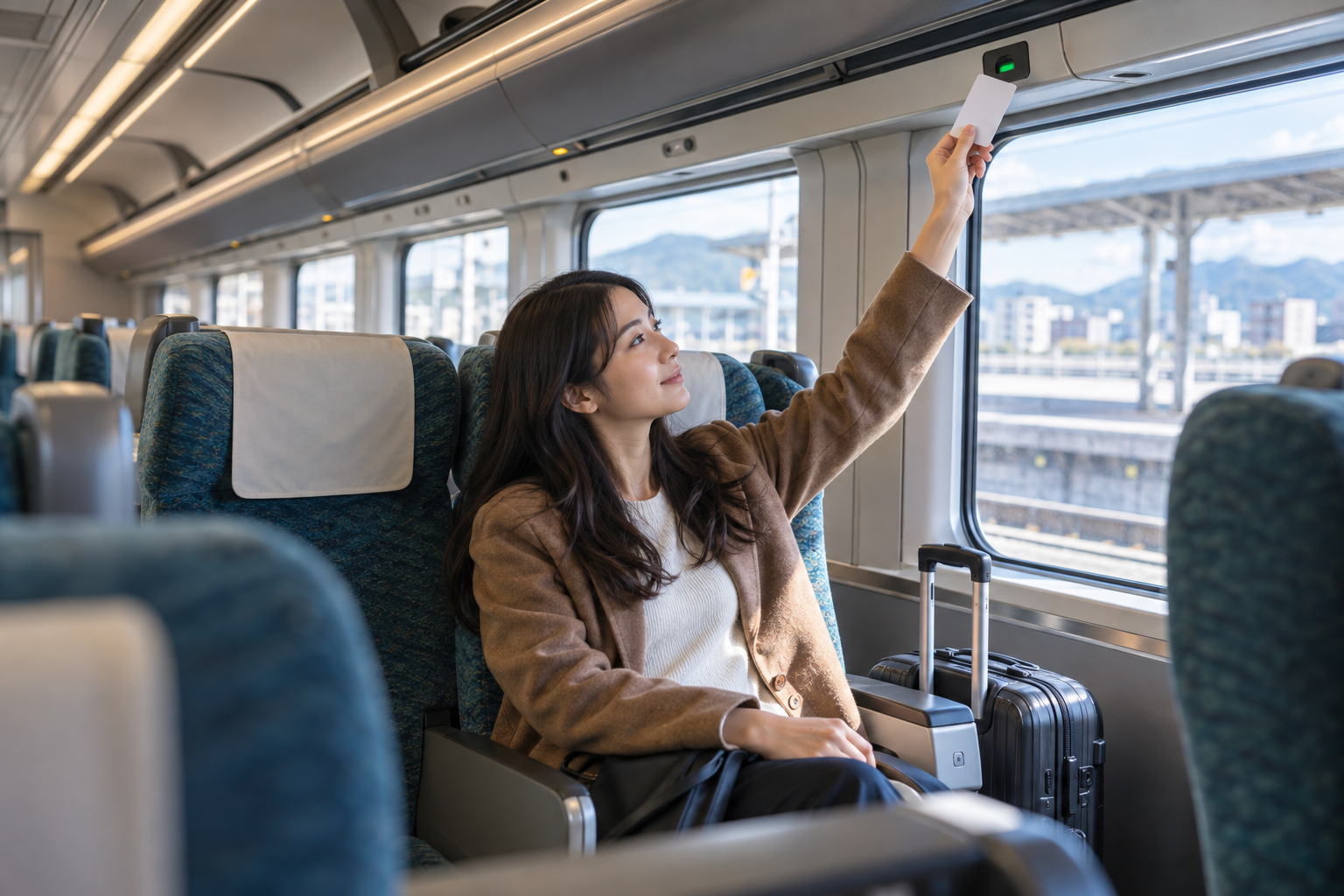
On JR East local Green Cars, red above the seat indicates that it is available; green indicates an occupied/registered seat.
- 6Tap the same IC card above your seat
Touch the card carrying your Suica Green Ticket to the overhead reader. The light changes from red to green, showing that your ticket is registered to that seat.
- 7Move or transfer correctly
If you change seats on the same train, touch the card at the new seat. For an eligible same-direction transfer without leaving the gates, follow JR East’s instruction to touch before getting off and again after boarding the next train.
- 8Exit normally
At your destination, use the same basic-fare ticket or IC card at the gate. The local Green Car ticket is valid for the purchased journey on that day.
If you want an overhead luggage rack, choose the single-level section at the end of a double-deck Green Car. JR East notes that the local Green Car has no dedicated oversized-luggage space.
If you buy a paper Green Car ticket
Board the Green Car, choose a seat showing a red light, and keep the paper ticket ready for the Green Attendant. Do not expect the overhead light to change simply because you hold a paper ticket. The attendant will check the ticket during the trip.
3. Current JR East local Green Car fares
JR East lists the following adult surcharges in addition to the basic fare. These amounts were checked on September 21, 2026.
| Distance | Suica Green Ticket | Paper Green Ticket |
|---|---|---|
| Up to 50 km | ¥750 | ¥1,010 |
| Up to 100 km | ¥1,000 | ¥1,260 |
| 101 km or more | ¥1,550 | ¥1,810 |
The Suica price applies when the Green ticket is recorded on an eligible Suica-family card or supported mobile product. JR East currently lists Suica, PASMO, Kitaca, and TOICA among the accepted physical IC cards, including specified Suica issuers; do not assume that every nationwide transit IC card can carry a Suica Green Ticket.
A ticket bought on board is sold at the higher paper-ticket fare. Buying before you enter the train is both simpler and cheaper when you have a compatible IC card.
4. Shinkansen and limited express Green Cars
For Shinkansen and most limited express trains, Green Car seating is reserved. You choose a specific train and receive a car number and seat number. Do not use the local-train “find a red light and tap above the seat” procedure.
- 1Choose the correct reservation service
Use SmartEX for the Tokaido, Sanyo, and Kyushu Shinkansen, JR-EAST Train Reservation for supported eastern Japan trains, or a JR reserved-seat machine or ticket office.
- 2Select “Green Car”
Confirm the date, stations, train name, departure time, and number of passengers. “Green” means the premium class; “Ordinary” means the standard car.
- 3Review the complete journey
Make sure the booking includes the basic fare and the required limited-express and Green charges, or that you already hold a compatible base ticket or pass.
- 4Confirm car and seat numbers
Use the seat map when available, then save the booking details. Green Cars on the Tokaido Shinkansen use two seats on each side of the aisle, but layouts differ on other trains.
- 5Board the reserved train
Line up at the platform marker for your car and sit in the exact assigned seat. If you miss a reserved Green Car train, the Green reservation itself generally cannot simply be carried to a later train.
On the Tokaido, Sanyo, and Kyushu Shinkansen, baggage with total dimensions over 160 cm and up to 250 cm requires a seat with an oversized-baggage area or compartment. “Green Car” by itself is not an oversized-baggage reservation.
5. What if you have a rail pass?
Read the conditions of your exact pass rather than assuming all Green Cars are included.
- Nationwide Green Japan Rail Pass: covers eligible Green Car travel shown in the official accommodation table, but reserved trains still require a seat reservation.
- Nationwide Ordinary Japan Rail Pass: does not include ordinary Green Car use without additional charges.
- Nozomi and Mizuho: nationwide pass holders need the separate pass-holder-only Nozomi/Mizuho ticket; the eligible class depends on whether the pass is Green or Ordinary.
- Regional passes: benefits differ. Many ordinary-class regional passes require extra Green and limited-express charges.
- SmartEX: its reservations are separate products and generally cannot be combined with a Japan Rail Pass.
6. Luggage and Green Car etiquette
- Keep aisles, decks, and doorways clear.
- Use the overhead rack only for baggage you can lift and secure safely.
- Do not place a suitcase on an empty seat unless you hold the required ticket for that seat and the operator permits it.
- Recline slowly and check the passenger behind you when practical.
- Use headphones, silence notifications, and take phone calls only where the train’s rules permit.
- Eat neatly, avoid strong odors, and take your rubbish with you or use the designated bin.
- Green Cars are non-smoking unless a train provides a separately designated smoking room.
7. If something goes wrong
| Problem | What to do |
|---|---|
| The local Green Car is full | Tell the Green Attendant before moving to an ordinary car. JR East says the attendant can issue the certificate needed for a refund; standing in the Green Car still requires a Green ticket. |
| The overhead light stays red | Try the same IC card used for the purchase. If it still fails, keep your purchase record available and ask the Green Attendant. |
| You changed seats | Tap the ticket-loaded IC card at the reader above the new seat. |
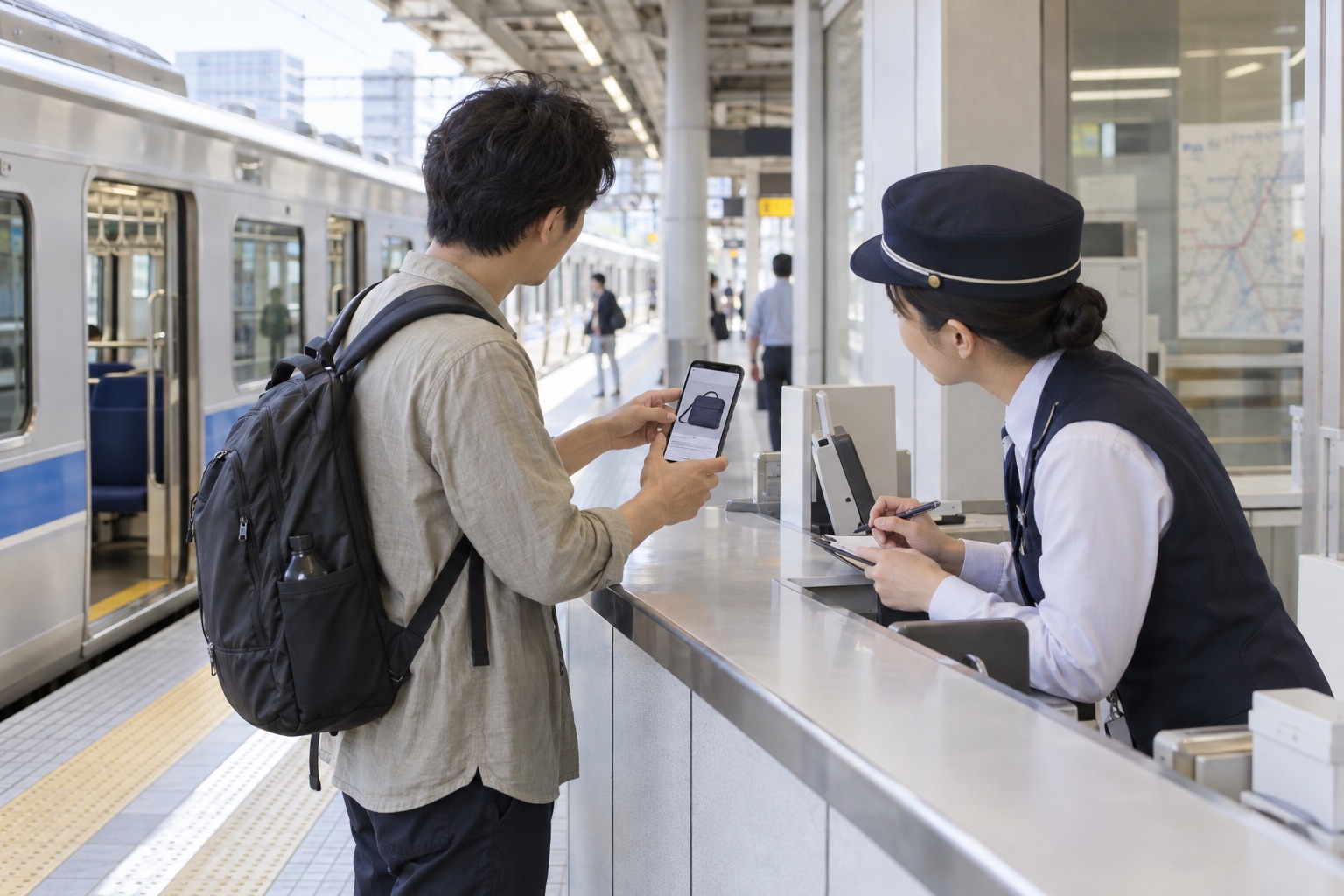
| You bought the wrong destination | Ask station staff or the Green Attendant before continuing beyond the purchased section. |
| You may miss a reserved train | Change the booking before departure when your ticket’s rules allow it. Green reserved-seat tickets are generally not valid after the specified train departs. |
| You boarded the wrong car | Move only when it is safe and permitted, or ask staff. Do not remain in a Green Car without the required ticket. |
8. Useful Japanese
| Japanese | Pronunciation | Meaning |
|---|---|---|
| この電車にグリーン車はありますか? | Kono densha ni gurīn-sha wa arimasu ka? | Does this train have a Green Car? |
| Suicaグリーン券を買いたいです | Suica gurīn-ken o kaitai desu | I would like to buy a Suica Green Ticket. |
| この席は空いていますか? | Kono seki wa aite imasu ka? | Is this seat available? |
| ランプが変わりません | Ranpu ga kawarimasen | The light does not change. |
| グリーン車は何号車ですか? | Gurīn-sha wa nangōsha desu ka? | Which car is the Green Car? |
| 予約を変更できますか? | Yoyaku o henkō dekimasu ka? | Can I change the reservation? |
9. Quick FAQ
Is a JR East local Green Car seat guaranteed?
No. It is a non-reserved service. You buy the right to use the Green Car, then choose an available seat. If every seat is occupied, speak to the Green Attendant before moving to an ordinary car.
What do the red and green lights mean?
On JR East local Green Cars, red marks a vacant/unregistered seat and green marks a seat registered to a Suica Green Ticket.
Can I buy the local Green ticket after boarding?
Yes, but JR East charges the higher paper-ticket fare. Buying a Suica Green Ticket before boarding is cheaper when you have a compatible IC card.
Can two people share one Suica Green Ticket?
No. Each traveler needs the appropriate basic fare and Green Car ticket.
Does every Shinkansen have a Green Car?
No. Equipment varies, and some services do not provide Green Cars. Search the exact train before booking.
Is GranClass the same as Green Car?
No. GranClass is a separate higher-grade product on selected Shinkansen services with different charges and pass rules.
This guide is independently written and uses JR service names only for identification. It does not reproduce railway photographs, route-map artwork, ticket-machine screenshots, or operator logos. Local-train procedures, routes, accepted IC cards, and fares were checked against JR East’s official Green Cars on Local Trains guide. Ticket combinations were checked against JR Central’s ticket combinations guide, and Tokaido–Sanyo–Kyushu Shinkansen booking details against the official SmartEX service. Pass coverage was checked against the official Japan Rail Pass accommodation table. Fares, routes, equipment, pass rules, and reservation conditions can change.