

Japan’s refund-method tax-free system now applies to eligible purchases made on or after November 1, 2026. You pay the tax-inclusive price at the store, prove at your departure airport or seaport that you are taking every registered item out of Japan, and receive the consumption-tax amount afterward from the shop or its refund provider.
I rechecked this guide on November 1, 2026 against the latest Japan Tourism Agency, National Tax Agency, Japan Customs, and Visit Japan Web guidance. Airport layouts, participating stores, refund providers, and operational details can still change, so confirm the official sources before departure.
I have experience assisting international travelers in English at an airport cosmetics store, so I pay particular attention to documents, packing, baggage check-in, and the difference between city tax-free shopping and airport duty-free shopping. The procedure below is based on current official government guidance; refund providers and airport operations can still vary.
Japan Customs now has a dedicated departure-procedure guide
I used the new English portal to confirm the passport scan, green or red result, seven-airport Visit Japan Web option, and final-departure-point rule. Before travel, I recommend using the official Customs Office Locations search to find the responsible customs office for your airport or seaport, then checking where its Tax Refund Kiosk and inspection area are located.
The purchase date—not your arrival or departure date—controls the procedure. Purchases through October 31 used the previous system. Purchases from November 1 use the refund method. If your trip crosses the changeover, keep the receipts from the two periods separate.
1. The quick answer
Buy → register → clear customs → receive the refund
Show your passport at a registered tax-free shop and pay the full tax-inclusive price. Follow the shop's instructions to register a refund destination. When leaving Japan within 90 days, complete the tax-free customs procedure before checking any bag that contains the goods. The shop or its provider processes the refund after customs confirmation.
For a non-food item priced at ¥10,000 before tax, the store would normally charge ¥11,000 including 10% consumption tax. The tax amount is returned only after the departure check succeeds. Your net refund can be lower if the shop or its provider charges a handling or currency-conversion fee, so ask for the expected amount before buying.
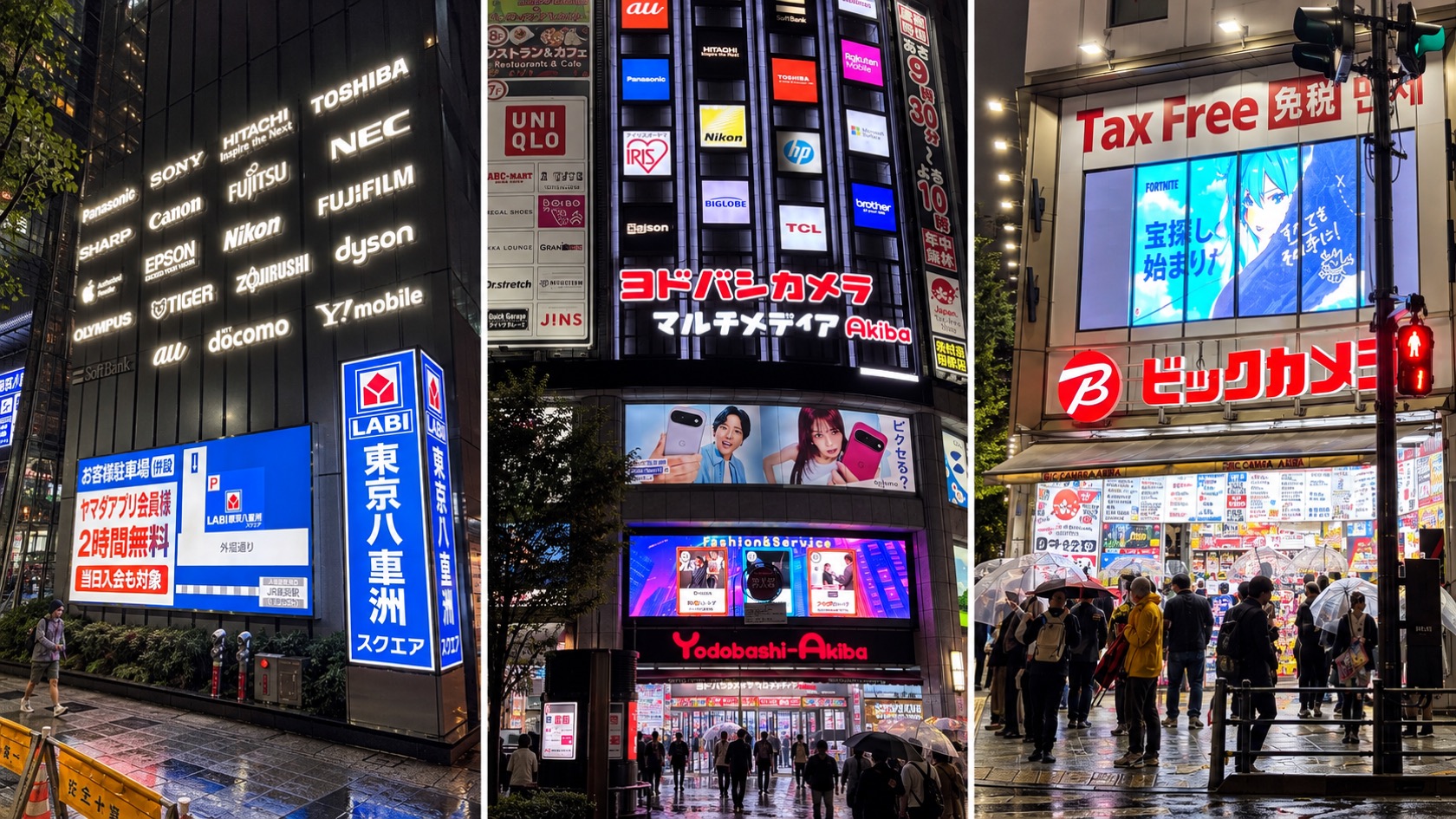
For a real electronics example, see my in-person Bic Camera, Yodobashi, and Yamada comparison. It shows why the tax-included shelf price—not a before-tax headline or an old-style tax-free label—is the safest starting point under the current system.
2. What changed on November 1, 2026?
| Point | Through Oct 31, 2026 | From Nov 1, 2026 |
|---|---|---|
| At the store | Tax is removed at checkout or refunded at the store counter. | You pay the tax-inclusive price and register the store's refund method. |
| At departure | Customs may inspect the goods under the current departure procedure. | You must complete customs confirmation within 90 days, before baggage check-in. |
| Product categories | General goods and consumables have different rules. | The category distinction is abolished. |
| Consumables | ¥5,000–¥500,000 before tax and special sealed packaging. | The ¥500,000 cap and special packaging are abolished, but consumables must still leave Japan unconsumed. |
| Minimum purchase | ¥5,000 before tax, subject to current category rules. | ¥5,000 before tax per eligible store per day; the minimum remains. |
| High-value items | No new detailed-item registration rule. | Items costing ¥1 million or more before tax require detailed identifying information in the purchase record. |
The reform is intended to reduce abuse in which goods bought tax-free are resold or left inside Japan. Under the refund method, the tax exemption becomes valid only after customs confirms that the registered goods are leaving the country.
3. Who qualifies?
For most international visitors, the usual qualifying status is Temporary Visitor. You must be a non-resident and be able to confirm that you have been in Japan for less than six months since entry. Diplomatic, Official, and certain landing-permit categories can also qualify.
- Foreign visitors: bring the original passport or the exact original landing document required for your status. A phone photo of a passport is not a substitute.
- Overseas-resident Japanese citizens: you must have lived outside Japan continuously for at least two years and prove it with an accepted document. From November 1, an overseas-move-recorded My Number Card—including its accepted smartphone version—can join a residency certificate or family-register attachment as supporting evidence.
- Japan residents departing on holiday: living in Japan and planning an overseas trip does not make you eligible.
- Where you shop matters: the store must be a registered tax-free shop. A large retailer or international brand is not automatically eligible.
The goods must be things you can personally carry and take out of Japan at departure. Gold or platinum bullion, gold or platinum coins, and items already exempt from consumption tax are excluded. Meals, hotel stays, transport, repairs, installation, and other services used in Japan are not tax-free retail goods.
Tax-free is not the same as duty-free
City-center tax-free shops remove Japanese consumption tax under the visitor system. Airport duty-free shops in the international departure area may also remove customs duty, liquor tax, or tobacco tax under different rules.
4. At the store: pay first and protect each transaction
- 1Confirm the branch is registered
Look for the tax-free logo or ask staff. Counter locations, hours, supported documents, and refund providers can differ by branch.
- 2Reach ¥5,000 before tax
The total is normally calculated at the same eligible store on the same day. An approved consolidated tax-free counter may combine participating shops within the same facility.
- 3Show the correct original document
Use the passport or landing document belonging to the actual purchaser. Eligible foreign visitors may show the official Visit Japan Web tax-free shopping 2D code at participating stores after registering their passport and landing-permit information. Screenshots are not accepted, and not every shop supports the code, so keep your original passport with you.
- 4Pay the tax-inclusive total
Budget for the full amount. A ¥10,000 non-food item normally costs ¥11,000 at checkout under the new system.
- 5Register the refund destination
The store will explain whether it uses a card, bank transfer, app, QR-linked service, or another method. Do not assume every store uses the same provider.
- 6Save the receipt and refund details
Receipts are not always required at the customs terminal, but customs may ask to see them and they are useful if a refund is delayed.
Customs checks each purchase record—usually each receipt—as one unit. Put snacks, drinks, or cosmetics you may use or consume during the trip in a separate normal-tax transaction. If one item is missing from a tax-free receipt, every item on that receipt can lose its refund.
5. During your trip: keep every registered item identifiable
- Do not consume food, drinks, medicine, cosmetics, or other consumables. Mandatory sealed packaging is abolished from November 1, so opening a package by itself is not the deciding issue. However, using or consuming any amount in Japan makes the purchase ineligible for customs confirmation.
- General goods may be used if you still take them out of Japan. A camera, laptop, clothing item, or bag does not automatically lose eligibility merely because you used it, but you must possess it at departure and customs must be able to identify it.
- Keep boxes and product labels when practical. Discarding packaging that carries the model or serial information can make customs identification difficult, especially for electronics and luxury goods.
- Do not give items away or leave them in Japan. Customs confirmation is based on the goods physically leaving Japan with the eligible purchaser.
- Watch the 90-day deadline. The count starts on the day after purchase. A purchase on November 1 has a customs-confirmation deadline of January 30.
If a receipt contains products A, B, and C but you have only A and B at departure, customs cannot approve that purchase record. The refund for A and B is lost together with C. If you consumed all or part of a registered consumable, skip the terminal procedure for that purchase and tell a customs officer at the counter.
6. At the airport or seaport: do this before baggage check-in
- 1Go to the international departure lobby early
The tax-free procedure terminals and customs inspection area are in the public departure area before airline baggage check-in.
- 2Keep all goods and your passport with you
Do not hand a suitcase containing registered goods to the airline first. Checked baggage cannot be retrieved merely to complete this procedure.
- 3Scan your passport at the terminal
Use the kiosk or electronic terminal. The automated result normally appears within seconds, although a physical inspection can take longer.
- 4Follow the green or red result
A green result completes the customs step. A red result means you must bring the goods to the designated customs inspection area.
- 5Check your luggage only after completion
Once customs finishes, place the goods in checked baggage if necessary and continue with the airline and security procedures.
At Narita, Haneda, Kansai, Chubu Centrair, Fukuoka, New Chitose, and Naha airports, travelers can also use Visit Japan Web for the procedure while connected to the dedicated Wi-Fi area in the international departure lobby before security. Set up and confirm that you can use Visit Japan Web before starting the customs procedure. You cannot complete this departure check from your hotel or after security; if the online procedure does not work, use the airport’s Tax Refund Kiosk.
For any departure point, check the official Japan Customs location search before travel. If your airport or seaport is not listed, confirm the responsible customs office with your airline, shipping company, or port operator in advance.
If you fly domestically and then connect to an international flight, complete the procedure at the airport where you actually leave Japan. Allow extra time: missing your flight because you started the tax-free process too late does not create a right to compensation.
Keep tax-free goods together in an easy-to-open section of your luggage, and save receipts and refund confirmations in one phone folder. This makes a red-result inspection much less stressful. If liquids must travel in checked baggage, complete the customs procedure first and check the suitcase afterward.
7. Getting the refund
Customs confirms export, but it does not normally pay the refund. The tax-free shop or its contracted provider sends the money after receiving the confirmation. Possible methods include a bank transfer, credit-card transfer, app-based payment, or cash at the departure port.
- Ask before paying: Which refund methods are available, which currencies are supported, and when should the money arrive?
- Check deductions: Japanese consumption-tax law does not standardize one operational refund method. A shop, provider, bank, card network, or currency conversion may reduce the amount you receive, so ask for the expected net refund before paying.
- Keep proof: save the receipt, refund registration confirmation, provider name, and contact route until the money arrives.
- Follow up with the right party: if customs approved the goods but the refund is delayed, contact the shop or refund provider—not the airport customs desk.
8. High-value goods, cruises, and overseas delivery
| Situation | What to do |
|---|---|
| Item costs ¥1 million or more before tax | Bring the item plus any authenticity certificate, warranty, or document that helps identify it. Customs may ask to see them. |
| Fly & cruise itinerary | If the cruise leaves Japan, visits an overseas port, returns to Japan, and you later fly out, complete the procedure at the Japanese airport where you finally depart—not during the temporary overseas port call. |
| Cruise that finally leaves Japan | Complete the procedure at the final Japanese port before baggage check-in, using the available electronic terminal and inspection area. |
| Shop-arranged direct overseas shipping | Ask before buying. If the seller arranges the qualifying export and hands the goods to the carrier at the shop, a separate export-tax exemption may apply and the traveler departure procedure may not be needed. |
| You mail the parcel yourself | This does not replace carrying the goods through customs. The former separate-shipment proof method was abolished on March 31, 2025. |
9. Save my traveler checklist
- Check whether your purchase date is before or after November 1, 2026.
- Carry the original passport or other required original document.
- Confirm the store is registered and the before-tax total reaches ¥5,000.
- Ask about the refund method, timing, fees, and currency before paying.
- Put anything you may eat, drink, use, consume, or give away on a separate non-tax-free receipt.
- Keep every registered product, receipt, identifying box, and refund confirmation together.
- Confirm that departure is no later than the 90th day after the purchase date.
- At departure, go to the tax-free terminal before checking any bag that contains the goods.
- Check the Japan Customs location search for your departure airport or seaport before travel.
- If using Visit Japan Web at one of the seven supported airports, set it up in advance and use the designated pre-security Wi-Fi area; use the kiosk if it does not work.
- After a red result, show all requested goods and supporting documents to customs.
- Keep your refund records until the money reaches you.
10. Quick FAQ
Can I combine purchases from different branches?
Normally no. The ¥5,000 threshold is calculated at the same eligible store on the same day. An approved consolidated counter in a participating shopping facility can be an exception, so ask before paying.
Can I use another traveler's passport?
No. The eligible purchaser must use their own passport or accepted document and must take the registered goods out of Japan.
Can I use a tax-free camera or laptop in Japan?
Under the refund-method rules, non-consumable goods may be used in Japan if you still possess and export the same identifiable item. Keep its model or serial information and packaging when practical. Consumables such as food and cosmetics cannot be partly or fully consumed.
Do I need the receipt at the customs terminal?
The terminal does not always require it because the purchase record is electronic, but customs may ask to see a receipt. Keep all receipts until the refund arrives.
Will every store refund in cash?
No. Refund method and timing depend on the store or provider. Ask about card, bank, app, cash, fees, and currency conversion before you buy.
Do I need Visit Japan Web to receive the refund?
No. The Tax Refund Kiosk or electronic terminal is the standard option. Visit Japan Web is an alternative at Narita, Haneda, Kansai, Chubu Centrair, Fukuoka, New Chitose, and Naha airports while connected to the designated Wi-Fi area before security. If it does not work, use the kiosk.
What if I lose or replace my passport after shopping?
Use the new passport at the departure terminal and tell a customs officer that purchases were also registered to the old passport number. Bring any record of the old passport if available.
11. Official Sources
- Japan Tourism Agency — Refund Method guide for travelers: the main English overview, with official leaflets in English, Japanese, Simplified Chinese, Traditional Chinese, and Korean.
- Japan Tourism Agency — Traveler FAQ: kiosk locations, green/red results, baggage timing, cruises, high-value goods, and refund methods.
- National Tax Agency — Refund Method reform hub: the detailed rules, Q&A documents, notices, and future updates.
- Japan Tourism Agency — Eligible purchasers under the Refund Method: the current nationality, status, passport, landing-permit, and overseas-resident Japanese document requirements.
- Japan Customs — Tax Exemption (Refund) Program for Foreign Visitors: the latest English departure flow, green/red result, and Visit Japan Web option.
- Japan Customs — Customs Office Locations: search for the customs office responsible for your departure airport or seaport.
- Digital Agency — Visit Japan Web: the official service guide and access point.
I originally published this guide on September 25, 2026 and rechecked it on November 1, 2026. Store providers, supported refund methods, fees, and airport operations can change, so confirm the store's terms and the latest official guidance before a high-value purchase.