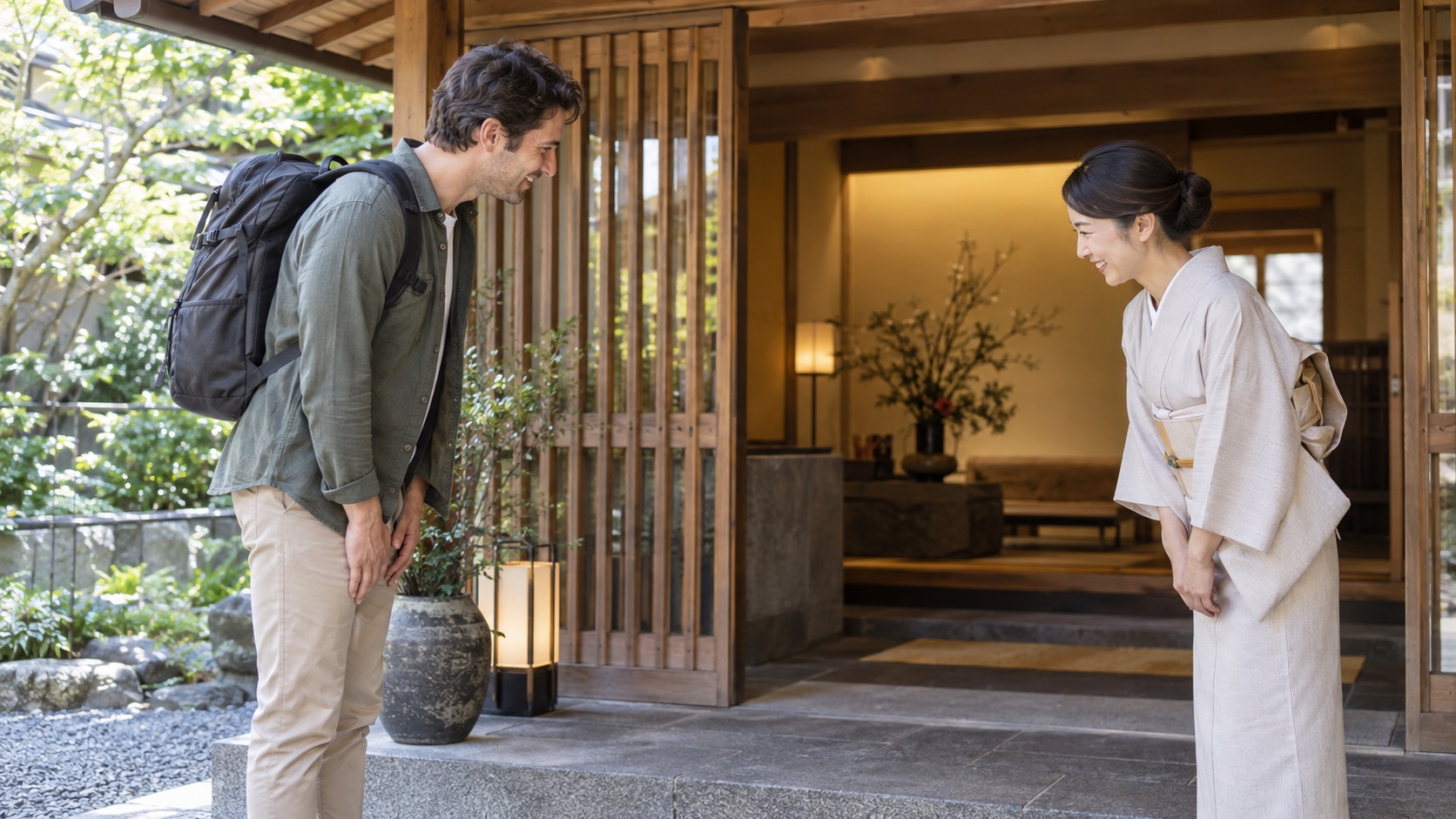
Travelers do not need to memorize formal bowing angles. In most everyday situations, say the appropriate greeting and add a relaxed nod or small bow. Sincerity, timing, and consideration matter more than perfect technique.
1. The quick rule
Match the moment, not an imagined ceremony
A brief bow works when meeting someone, thanking staff, apologizing, or saying goodbye. If the other person offers a handshake, accept it normally. Many people meeting international visitors combine a small bow with a handshake or spoken greeting.
2. When travelers commonly bow
- Greeting someone: a nod or shallow bow with ohayō gozaimasu or konnichiwa.
- Thanking staff: a small bow with arigatō gozaimasu.
- Receiving help: bow after directions, assistance, or the return of a lost item.
- Apologizing: a slightly more deliberate bow with sumimasen is enough for a small mistake.
- Entering or leaving: hosts, hotel staff, guides, and guests may exchange a bow at the beginning and end of an interaction.
You do not need to bow to every passerby, shop display, train conductor, or person who happens to make eye contact. Bowing is communication, not a performance.
3. How to make a simple respectful bow
- 1Stop and face the person
Keep a comfortable distance and do not bow while rushing past them.
- 2Stand naturally
Keep your back straight. Let your arms rest at your sides or place your hands calmly in front.
- 3Bend gently from the waist
A small movement is enough for an everyday greeting or thanks.
- 4Pause briefly, then rise
Do not bounce repeatedly or hold an exaggerated deep bow.
- 5Continue the conversation
Speak normally and follow the other person’s lead.
Formal workplaces and ceremonies use more precise conventions, but tourists are rarely expected to know them. A calm shallow bow avoids parodying a ritual you do not need to perform.
4. Everyday greetings worth learning
| Japanese | Pronunciation | Use |
|---|---|---|
| おはようございます | Ohayō gozaimasu | Good morning |
| こんにちは | Konnichiwa | Hello / good afternoon |
| こんばんは | Konbanwa | Good evening |
| はじめまして | Hajimemashite | Nice to meet you, first meeting |
| よろしくお願いします | Yoroshiku onegaishimasu | Polite phrase after an introduction or request |
| 失礼します | Shitsurei shimasu | Excuse me; used when entering, interrupting, or leaving |
5. Choosing the right thank-you
| Phrase | Tone | Good situation |
|---|---|---|
| ありがとう | Casual | Friends or relaxed familiar situations |
| ありがとうございます | Polite | Shops, hotels, restaurants, strangers |
| ありがとうございました | Polite, completed action | As a tour, stay, or service ends |
| すみません | Excuse me / appreciative apology | Someone went to trouble to help you |
| ごちそうさまでした | Thanks for the meal | When leaving a restaurant or after being hosted |
| 助かりました | That helped me | After practical assistance |
If you only remember one phrase, use arigatō gozaimasu. Say it clearly, smile, and add a small bow. That combination works in more situations than a long memorized speech.
Sumimasen can sound like “sorry,” “excuse me,” or “thank you for the trouble,” depending on context. Use it to get a server’s attention or acknowledge that someone made an extra effort, then add arigatō gozaimasu for an unambiguous thank-you.
6. A simple first introduction
For a host, guide, class, or business contact, you can say:
“Hajimemashite. [Name] desu. Yoroshiku onegaishimasu.”
“Nice to meet you. I’m [Name]. I look forward to getting along with you.” Add a small bow at the end. There is no need to force a Japanese word order if the other person is speaking English.
In a formal exchange, receive a business card with both hands and take a moment to read it before putting it away carefully. In an ordinary tourist interaction, no card ritual is needed.
7. Common mistakes to avoid
- Overly deep bowing: it can look theatrical in a casual encounter. Keep it small.
- Pressing palms together: this is not the standard Japanese greeting gesture. Keep your hands relaxed.
- Bowing while shaking hands: a tiny nod may happen naturally, but do not fold deeply and create an awkward grip.
- Using casual arigatō everywhere: choose arigatō gozaimasu with staff, strangers, and elders.
- Copying every bow: one sincere response is enough; you do not need an endless bowing loop at the door.
8. Quick FAQ
Should I make eye contact while bowing?
Face the person before the bow, then let your gaze lower naturally with your head. Look up again as you rise.
Is a handshake rude?
No. If someone offers one, respond normally. Japanese people who work with overseas visitors may choose a handshake, a bow, or both.
Do women and men bow differently?
Hand placement can differ in formal instruction, but visitors can simply keep arms relaxed and make the same small respectful bow.
What if I forget the Japanese phrase?
A clear “thank you,” friendly expression, and small bow communicate well. Politeness matters more than vocabulary.
This independently written guide was checked against the Japan National Tourism Organization’s official Custom & Manners, Japanese Manners Do’s and Don’ts, and Japanese Customs and Etiquette. Formal ceremonies and workplaces may use more specific protocols; visitors should follow their host’s guidance.